
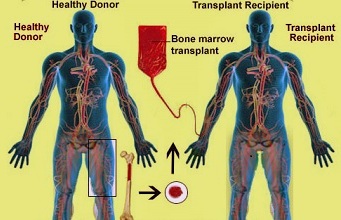
What is Bone Marrow Transplant
Bone marrow transplant is a medical treatment performed to replace unhealthy bone marrow that has been damaged or destroyed by disease, infection, or chemotherapy with a healthy bone marrow. The procedure involves transplanting blood stem cells, which travel to the bone marrow where they produce new blood cells and promote growth of new marrow.
?What is a Bone Marrow?
Bone marrow is a soft spongy tissue that fills the center of the bones (known as the medullary cavity) and produce immature blood forming cells, called as stem cells. These immature cells further mature into red blood cells, white blood cells, platelets. 
-
Red blood cells role is to carry oxygen & nutrients throughout the body
-
White blood cells role is to help the body fight against infections
-
Platelets helps in control bleeding, by formation of clots
There are two types of bone marrows stem cells:
-
Hematopoietic stem cells: Red bone marrow (also known as myeloid tissue) consists of a delicate, highly vascular fibrous tissue containing hematopoietic stem cells, which are the blood-forming stem cells.
-
Mesenchymal stem cells: Yellow bone marrow (fatty tissue) contains mesenchymal stem cells, also known as marrow stromal cells, which produce fat, cartilage and bone.
It is these stem cells that play a major role in bone marrow transplant because of their unique characteristic of:
-
Renewal: can reproduce another cell identical to itself
-
Differentiation: can generate one or more subsets of more mature cells.
Stem cells constantly divide and produce new cells. Stem cells rapidly multiply to make millions of blood cells each day. Blood cells have a limited life span (around 100-120 days for red blood cells) and are constantly being replaced. The production of healthy stem cells is vital.
Why is a bone marrow transplant needed?
They are performed when a person’s marrow has been destroyed by a disease or isn’t healthy enough to function properly.
A bone marrow transplant can be used to:
-
Replace diseased, nonfunctioning bone marrow with healthy functioning bone marrow (for conditions such as leukemia, aplastic anemia, and sickle cell anemia).
-
Regenerate a new immune system that will fight existing or residual leukemia or other cancers not killed by the chemotherapy or radiation used in the transplant.
-
Replace the bone marrow and restore its normal function after high doses of chemotherapy and/or radiation are given to treat a malignancy.
-
Replace bone marrow with genetically healthy functioning bone marrow to prevent further damage from a genetic disease process.
?Diseases that may benefit from Bone Marrow Transplant
Following are few of the diseases that are benefited from bone marrow transplant:
-
Leukemia’s
-
Severe aplastic anemia
-
Sickle cell anemia
-
Lymphomas
-
Thalassemia
-
Multiple myeloma
-
Immune deficiency disorders
-
Some solid-tumor cancers (in rare circumstances)
However, every patient experience diseases differently, and bone marrow transplant may not be appropriate for everyone who suffers from these diseases.
Different types of Bone Marrow Transplant
There are three types of bone marrow transplant. The main distinction between the types of bone marrow transplant (BMT) has to do with whose stem cells are being transplanted. The type used will depend on the reason needed for the transplant.
How a Bone Marrow Transplant works
A stem cell or bone marrow transplant is a long and complicated process that involves five main stages. These stages are:
?Test & examination
Before a stem cell transplant is to be carried out, a series of tests and examinations are done to ensure that the patient is healthy enough for the procedure to be carried out. These test will also help in evaluating if a bone marrow transplant will be safe and beneficial for the patient.
The tests include:
-
Physical examination
-
Imaging test
-
Electrocardiogram (ECG) – a simple test used to check your heart's rhythm and electrical activity
-
Echocardiogram – a scan used to look at the heart and nearby blood vessels
-
X-ray and/or computerized tomography (CT) scan to check the condition of organs such as the lungs and liver
-
Pulmonary function test: determines how much air is taken into the lungs when the patient inhales, how much is let out with each exhale and how quickly breath is exhaled. This helps doctors determine whether there any problems with the patient's lungs
-
Blood tests to check the level of blood cells and assess how well the liver and kidneys are working
-
Tests of small pieces of bone marrow (biopsy) to evaluate the patient condition.
?Harvesting
The process of collecting (harvesting) stem cells for transplant depends on the source of the stem cells. Stem cells can be collected from bone marrow, circulating (peripheral) blood or umbilical cord blood.
Stem cells from bone marrow
The hip (pelvic) bone contains the largest amount of active marrow in the body and large numbers of stem cells. Harvesting stem cells from the bone marrow is usually done in the operating room.
-
Person will be given an epidural (spinal) or general anesthetic.

-
Doctor will make several small punctures in the skin over the pelvic bone.
-
A special needle attached to a syringe is inserted through these punctures and into the bone marrow.
-
Doctor will draw marrow and blood out of the bone through the syringe. This process is repeated until enough stem cells are collected for the transplant. It usually takes 1–2 hours.
-
After the procedure, the doctor covers the puncture sites with bandages or a pressure dressing.
-
The cells collected are filtered to remove bone fragments and fat particles.
-
The donor recovers from the anesthetic in the recovery room. Any signs of bleeding, pain or any other side effects from the procedure will be checked. The donor can usually leave the hospital a few hours after the procedure. Sometimes the donor will need to stay in the hospital overnight to recover from the procedure.
-
The donor’s hip area may be sore for a few days, which can be taken care of by pain killers.
Few risks are associated with donating bone marrow. The body usually replaces these cells within a few weeks. The doctor may suggest iron supplements until blood cell counts increase.
Sometimes blood is collected from the donor a few weeks before the bone marrow harvest. The blood is stored and given back to the donor after the stem cells are removed. This blood transfusion helps prevent anemia.
Stem cells from circulating blood (peripheral blood)
The most common way to harvest stem cells involves temporarily removing blood from the body, separating out the stem cells, and then returning the blood to the body. Harvesting stem cells from peripheral (circulating) blood is done on an outpatient basis. No anesthetic is needed.
-
To boost the number of stem cells in the blood, the person may be given a hematopoietic growth factor drug called colony-stimulating factor (CSF).that stimulates their production .This medication will be given for about four days beforehand.
-
On the fifth day, a blood test will be carried out to check whether they are enough circulating stem cells or note`.
-
If there are enough cells, veins in each arm will be connected by tubes to a cell-separator machine.
-
Blood is removed from one arm and passed through a filter, before being returned to the body through the other arm.
-
It takes around three hours and may need to be repeated the next day if not enough cells are removed the first time.
-
This procedure isn't painful and is done while the patient is awake.
Stem cells from umbilical cord blood
Blood is collected from the umbilical cord shortly after a baby is born. The volume of stem cells collected per donation is quite small, so these cells are usually used for children.
-
A machine separates and collects stem cells from the cord blood.
-
The stem cells are frozen and stored by cord blood banks or programs until they are needed.
Conditioning
Conditioning is the name given to high dose chemotherapy or radiotherapy to destroy or suppress patients existing bone marrow so that donor stem cell can home in bone marrow and start functioning. Drugs used in conditioning differs by the underlying condition for which transplant is being done.
After the patient is approved for a bone marrow transplant, patient will have a conditioning treatment to kill cancer cells in the body and suppress the immune system before a bone marrow transplant.
?Transplanting the Stem Cells
In a bone marrow transplant, doctors infuse or inject healthy stem cells into your body to renew and repair tissue. After conditioning, patients rest for a day or two to allow the drugs to be cleared from their systems.
-
Before the transplant begins patients are examined by the doctor in-charge.
-
The patient receives medication to help prevent side effects.
-
The stem cells will be passed slowly into the patient’s body through the central line. This process often takes around a couple of hours.
-
The DMSO used as a preservative causes some patients to sense a taste and smell similar to garlic during the transfusion and for a day or two afterward. Some patients may become nauseated. Other side effects are also possible.
-
Patient is also given IV fluids (hydration) before and after the bone marrow transplant to help the body get rid of the preservatives.
-
Transplant is not a painful procedure and the patient will be awake thought the procedure.

?Recovery
Once the transplant is finished, the patient need to stay in the hospital for a few weeks to wait for the stem cells to settle in the bone marrow and start producing new blood cells. In the hospital, the patient will be isolated because of the increased risk of infection. The team of doctors will closely monitor the blood count and vital signs.
The duration of stay in the hospital depends on:
-
How much chemotherapy or radiation the patient has received
-
The type of transplant performed
-
Before the discharge , the doctor will make sure
-
Bone marrow is making enough healthy blood cells
-
Patient has no severe complications
-
Patient feel well and any mouth sores and/or diarrhea have improved or gone away
-
Appetite has improved
-
There is no fever or vomiting
Cost
India provides cost effective treatments to its patients. The cost of bone marrow transplant in India, therefore is also much less than what it is in other countries abroad. Check out the links below to know the cost of bone marrow transplant in India thoroughly:
During the hospital stay patient might
-
Feel weak, and may experience vomiting, diarrhea and/or a loss of appetite
-
Receive medicines to prevent or treat infections, including antibiotics, antifungals, and antiviral medicine
-
Need many blood transfusions, cause of a low number of red blood cells
-
Have regular platelet transfusions, cause of a low number of platelets
-
Be fed through a vein until you can eat by mouth and stomach side effects and mouth sores have gone away
During the first weeks and months after leaving the hospital, the patient will have to make frequent trips to an outpatient clinic. This will allow the doctors to track the patient’s progress. These visits will become less often over time.
Staff at the clinic will teach the patient and their caregiver how to care for your central line (which will stay in place for at least 6 months after your transplant), how to watch for and prevent infections, and other ways to care
Recovery from a stem cell transplant can be slow. It takes 6 to 12 months to recover normal blood cell levels and immune function. During this time, it's important to take steps to reduce the risk of infection, get plenty of rest, and follow the doctor’s instructions about medicines and checkups.
Risk Involved
Stem cell or bone marrow transplants are complex treatments that carry a significant risk of serious complications. Generally, younger people who don't have any other serious conditions or those who receive transplants from a closely matched sibling are less likely to experience serious problems. People receiving transplants of their own stem cells (autologous transplants) are also less likely to experience serious side effects. The main risks of a blood and marrow stem cell transplant are infections, graft-versus-host disease (GVHD), and graft failure.
?Graft-versus-host disease (GVHD)
In some cases, the transplanted cells recognize the recipient's cells as "foreign" and attack them. This is known as graft versus host disease (GVHD). At times these cells can recognize their own tissues as being foreign and attack them. This can be an advantage as they may also attack any cancer cells that are left after the treatment. It can occur within a few months of the transplant or develop several months or occasionally a year or two later. The condition is usually mild, but can sometimes be life-threatening.
Symptoms of GVHD includes:
-
an itchy rash
-
feeling and being sick
-
a sensitive and dry mouth
-
dry, flaky skin
-
yellowing of the skin and whites of the eyes (jaundice)
If a patient develops GVHD after the transplant, doctor will prescribe drugs to damp down the immune reaction. These drugs are called immunosuppressive.
Infections
Patients can easily catch infections after the transplant because of the weak immune system. The risk of infections decreases as the immune system recovers.
Following steps can be taken to prevent infections:
-
Room must be thoroughly cleaned on daily basis.
-
Bathing or showering daily
-
Carefully cleaning the teeth and gums
-
Cleaning the area where the central line enters the body
-
Avoiding foods that may have harmful bacteria, such as raw fruits and vegetables
-
Avoid having lightly cooked or raw eggs.
Transplant recipients sometimes are given vaccines to prevent viruses and infections, such as the flu and pneumonia. If a patient develops an infection, the treating doctor will prescribe medicines to treat.
?Graft failure
Graft failure occurs if the immune system rejects the new stem cells. It also can occur if
-
Not enough stem cells are used,
-
The new stem cells are damaged during storage,
-
Bone marrow is damaged after the transplant.
-
People who get stem cells from poorly matched donors also are more likely to have graft failure.
-
It is also more likely to occur in people who receive less preparation for their transplants
Other complications
These may include:
-
Bleeding in the lungs, intestines, brain, and other areas of the body
-
Clotting in the small veins of the liver
-
Damage to the kidneys, liver, lungs, and heart
-
Delayed growth in children who receive a bone marrow transplant
-
Early menopause
-
Inflammation and soreness in the mouth, throat, esophagus, and stomach, called mucositis
-
Pain
-
Stomach problems, including diarrhea, nausea, and vomiting
-
Cancer relapse
Prognosis:
How well a patient responds to the transplant depends on:
-
The type of bone marrow transplant done
-
How well the donor's cells match the patients cell
-
What type of cancer or illness the patient is suffering
-
Patients age and overall health
-
The type and dosage of chemotherapy or radiation therapy the patient had undergone before the transplant
-
Any complications the patient may have
A bone marrow transplant may completely or partially cure the illness. If the transplant is a success, the patient can go back to most of the normal activities as soon as the patient feel well enough. Usually it takes up to 1 year to recover fully, depending on what complications occur. Complications or failure of the bone marrow transplant can lead to death.
Alternative names of Bone Marrow Transplant
-
Transplant - bone marrow
-
Stem cell transplant; Hematopoietic stem cell transplant
-
Reduced intensity, non-myeloablative transplant
-
Mini transplant; Allogenic bone marrow transplant
-
Autologous bone marrow transplant
-
Umbilical cord blood transplant
Myths & Facts about Bone Marrow Transplant
MYTH: All bone marrow donations involve surgery.
FACT: Majority of bone marrow donations do not involve surgery. Today, the patient’s doctor most often requests a peripheral blood stem cell (PBSC) donation, which is a non-surgical procedure
MYTH: Donating bone marrow is painful and involves a long recover
FACT: Donating bone marrow can have an uncomfortable but short-lived side effects. This is because of taking a drug called filgrastim .Donors may have headaches, joint or muscle aches, or fatigue. Mostly the donors are back to their normal routine in one to two days.
MYTH: Donating bone marrow is dangerous and weakens the donor.
FACT: Though no medical procedure is without risk, but there are rarely any long-term side effects.
MYTH: In marrow donation, pieces of bone are removed from the donor.
FACT: No pieces of bone are taken during marrow donation. Bone marrow is a fluid within the cavities of your bones and contains stem cells which are the source of all blood cells. Only this liquid marrow found inside the bone is needed to save the patient’s life.
Myth: Most patients will receive their marrow from a family member
FACT: 70% of the patients will receive their marrow from a stranger
Myth: I can’t donate marrow because I can’t donate blood (I’m underweight / I’m anemic / I have diabetes, etc.).
FACT: Requirements for donating blood are very different from donating bone marrow/blood stem cells. There is no underweight requirement for bone marrow donation but there is a maximum weight requirement. People who are anemic (low iron) can donate and even those with diabetics whose condition is not controlled by insulin can also donate. However, if they experience chronic back/hip/spine problems that requires medical attention, or if they have had a disc problem, then they may not be allowed to donate.